Fantasy town maps with the walls already in
Most town generators give you a picture. Put that picture in Foundry or Roll20 and every building is just paint: tokens walk through walls and see through houses until you trace them by hand. Mapsmith draws the town and saves it as a Universal VTT file (.dd2vtt), so every building and the town wall arrive as walls and the gates as doors.
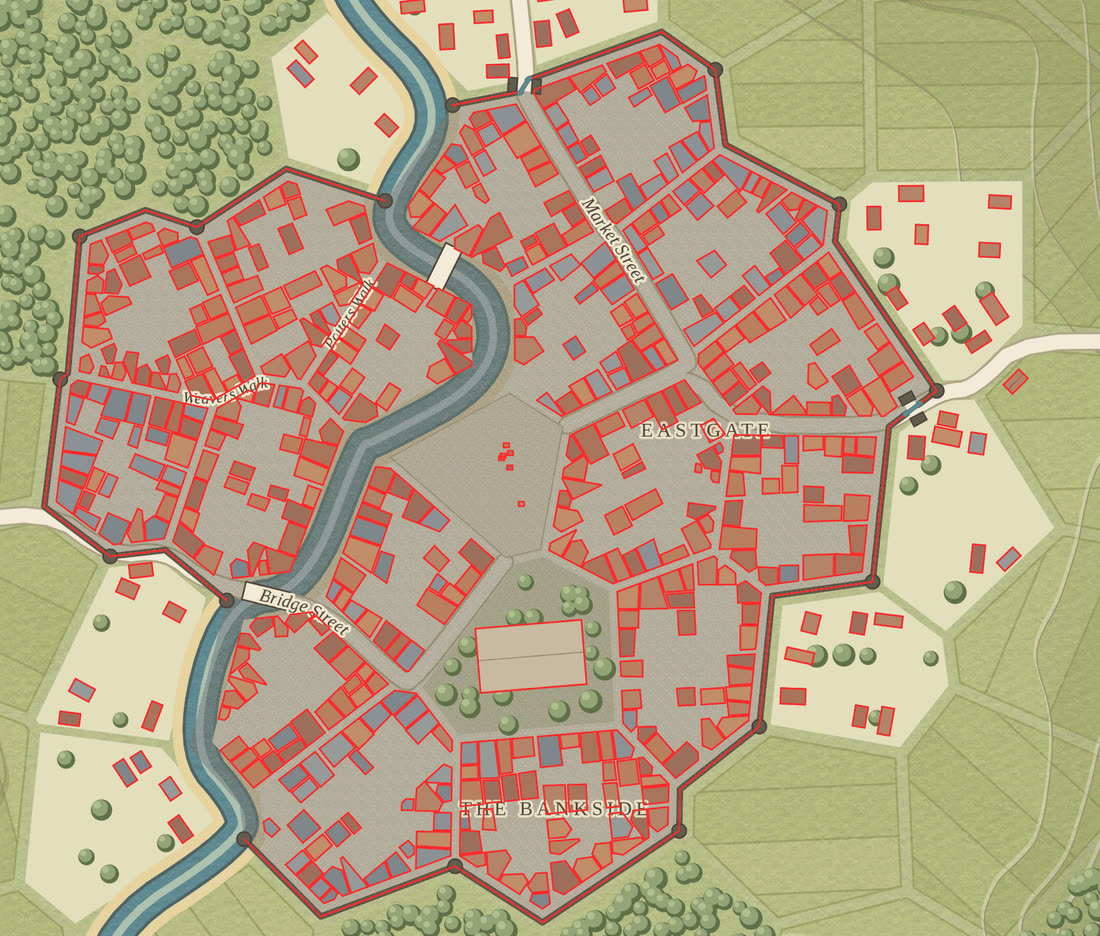
A town as a virtual tabletop reads it: walls in red, gates in blue, on a five metre grid.
What it draws
- Towns from a hamlet to a city: streets, wards, a market, bridges over a river, docks on a coast or an estuary, walls and gates, fields and woods outside, hills or mountains behind.
- Numbered places: the market, the temple, the inn, the smithy, the harbour. Each has a name, who keeps it, what it’s like and a hook. Each building also has a floor plan of its inside.
- The country around: a region about 40 km across with towns, villages, roads and ruins, each one opening into its own town or dungeon map.
- Dungeons and ships too: crypts, fallen keeps, old mines, and spaceship deck plans.
The same seed always draws the same town, so it never changes under you.
Where it runs
Mapsmith is a free plugin for Obsidian, the notes app many GMs keep their campaign in. The map is drawn inside your note from a short block of text, and clicking a place writes a note for it. You can try it in your browser first: that page runs the plugin’s own code.
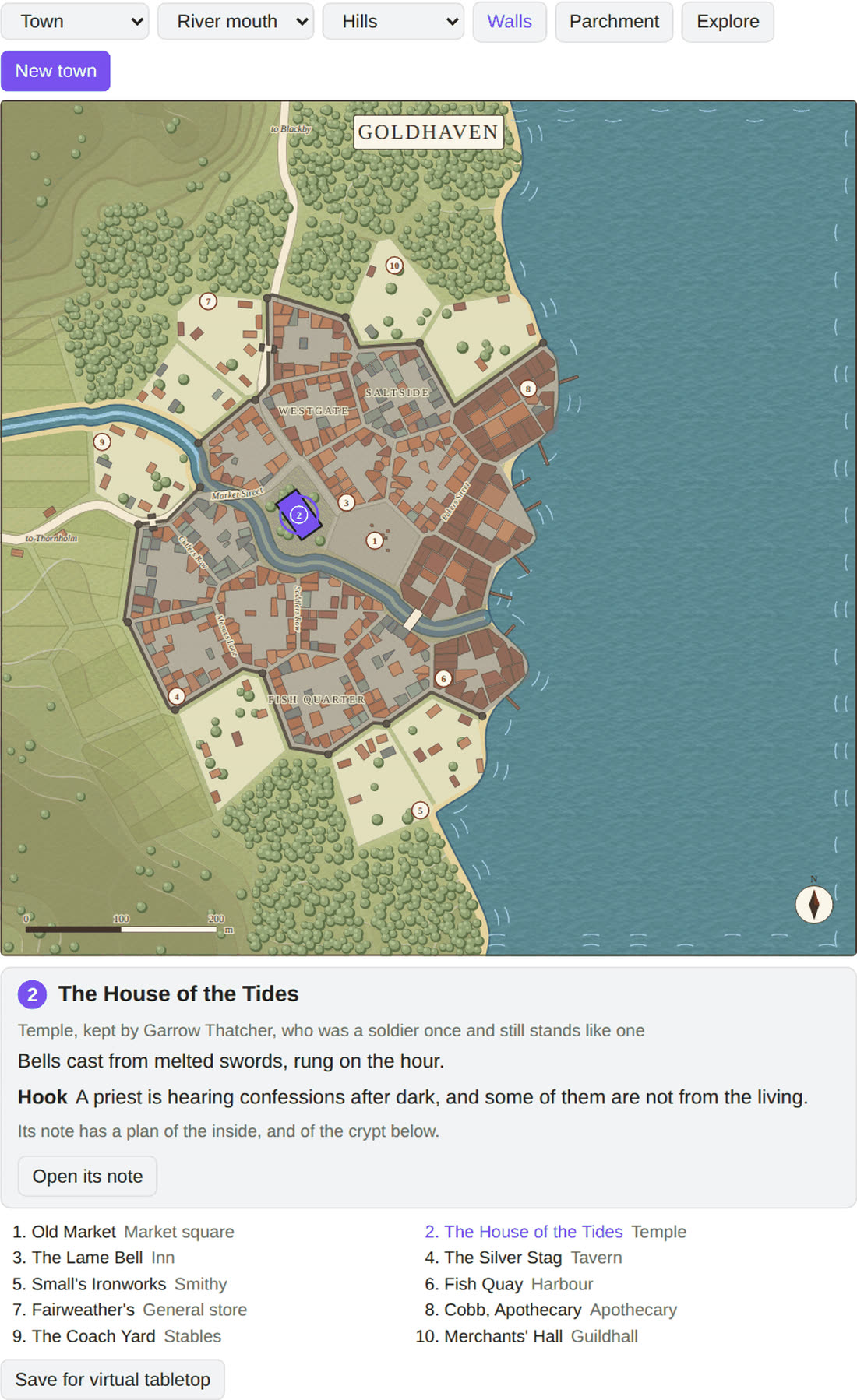
- In Obsidian: Settings, Community plugins, Browse, search Mapsmith, Install, Enable.
- Run Insert a town map from the command palette. The bar above the map changes the size, the water, the hills and the walls; New town rolls another.
- With Mapsmith Pro ($6 once), press Save for virtual tabletop under the map. The
.dd2vttlands beside your note.
Into your virtual tabletop
- Foundry VTT: the Universal Battlemap Importer module reads the
.dd2vttas a scene with its walls, doors and lights. - Roll20: import the
.dd2vttand the walls come in as dynamic lighting. - Owlbear Rodeo: the Scene Importer extension with Dynamic Fog. Step by step.
The saved map is the players’ map: no numbers on it, and secret doors in a dungeon are drawn as plain wall. Towns are on a five metre grid (ten for a large town or city). A region saves as a travel map with its place names, a kilometre a square.
Exploring alone
Press Explore and the town or dungeon hides everything you haven’t been to. Click a question mark to walk there and roll what you find. Where you’ve been is written into the note, so solo play picks up where it left off.
Mapsmith is free and open source (MIT); Pro adds the VTT save. Made by Bananafest Destiny. The code was written with AI, and the textures under the maps (grass, cobbles, stone, water) were made with an image generator; the maps themselves are drawn by code. Foundry VTT, Roll20, Owlbear Rodeo and Obsidian are their owners’ trademarks, named only to say what Mapsmith works with.